
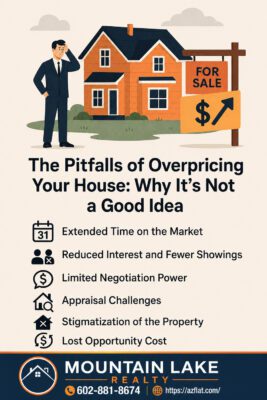
The Pitfalls of Overpricing Your House: Why It’s Not a Good Idea
When selling a home, it can be tempting to list the property at a higher price. After all, every homeowner wants to get the most money possible.
But overpricing your house can actually make it harder to sell—and may ultimately result in receiving less money.
Today’s buyers have access to extensive information about comparable homes, recent sales, price reductions and how long properties have been sitting on the market. When a home is priced substantially above its market value, buyers may simply skip it.
Whether you’re selling a home in Phoenix, Scottsdale, Glendale, Peoria, Prescott or elsewhere in Arizona, establishing the right asking price is one of the most important decisions you will make.
1. Extended Time on the Market
One of the biggest problems with overpricing is that the home may sit on the market for an extended period.
When a property first hits the MLS, it can receive significant attention from buyers who are actively searching for new listings. If the price is too high, those buyers may pass.
Eventually, the listing can become what real estate professionals call “stale.”
Buyers may begin wondering:
Why hasn’t this home sold?
Is something wrong with the property?
Has the seller already rejected offers?
Will the seller eventually accept a much lower price?
A property that sits for months can lose some of the excitement and urgency that accompanies a new listing.
2. Reduced Interest and Fewer Showings
Price is one of the first things buyers consider when searching online.
Fewer buyers seeing your home means fewer opportunities for an offer.
This is especially important because online real estate searches make it extremely easy for buyers to compare your property against competing listings.
3. Limited Negotiation Power
Some sellers believe that starting with a high asking price gives them room to negotiate.
In reality, an excessively high price can have the opposite effect.
A correctly priced home can create more interest and potentially give the seller greater negotiating leverage.
4. Appraisal Challenges
Even when a buyer agrees to pay your asking price, the transaction may still face an appraisal problem if the buyer is obtaining financing.
For example, suppose you agree to sell your home for $600,000, but the appraiser determines that the property’s market-supported value is only $550,000.
That could result in:
A renegotiation
A larger buyer down payment
A request for the seller to reduce the price
A delayed closing
Or, in some circumstances, the transaction falling apart
Pricing a home based on recent comparable sales and current market conditions can help reduce the risk of a major appraisal gap.
5. Stigmatization of the Property
A home that has been listed for a long time can develop a negative perception among buyers.
Repeated price reductions can make the situation even more noticeable.
For example:
$625,000 → $599,000 → $575,000 → $549,000
Instead of seeing a desirable property, buyers may wonder why the seller has been unable to sell it.
Some buyers may even assume that the seller has become desperate and make substantially lower offers.
6. Lost Opportunity Cost
Perhaps the biggest cost of overpricing isn’t always obvious.
While your home is sitting on the market, you may be missing opportunities to:
Move into another property
Purchase your next home
Relocate
Invest the proceeds
Reduce carrying costs
Take advantage of favorable market conditions
You are also continuing to pay expenses such as mortgage payments, property taxes, insurance, utilities and maintenance.
Time on the market has a financial cost.
How Should You Price Your Arizona Home?
The best asking price isn’t necessarily the highest number you can put on the MLS.
Instead, the goal is to determine a price that reflects the property’s current market value while attracting qualified buyers.
A good pricing analysis should consider:
Recent Comparable Sales
Look at homes that are similar in size, location, condition, features and age that have actually sold.
Current Competition
What are buyers choosing between right now?
Location
Neighborhood, school boundaries, amenities, traffic, views and other location factors can influence value.
Condition
A remodeled home generally competes differently from a property that needs substantial repairs or updating.
Market Conditions
Supply, demand, mortgage rates and buyer activity can all influence pricing.
Days on Market
Recent sales that moved quickly can provide useful clues about where buyers are willing to pay.
Don’t Confuse “Highest Price” With “Highest Net”
The objective isn’t simply to put the highest possible price on your house.
The objective is to maximize your net proceeds while getting the property sold.
For example, a home that starts $50,000 above market value may eventually require multiple price reductions and months of additional carrying costs.
A strategically priced home may attract more buyers early, generate stronger interest and potentially create better opportunities for the seller.
The Bottom Line for Arizona Home Sellers
Overpricing your house can cost you more than you realize.
An unrealistic asking price can lead to extended time on the market, fewer showings, weaker negotiating power, appraisal problems, repeated price reductions and lost opportunities.
Before putting your Arizona home on the market, take the time to understand what comparable properties are actually selling for—not simply what other sellers are asking.
Price your home to attract buyers, not to discourage them.
Sell Your Arizona Home With Mountain Lake Realty
If you’re considering selling your home in Arizona, Mountain Lake Realty offers an alternative to traditional high-commission listing models.
Mountain Lake Realty
602-881-8674
azflat.com
Arizona home sellers should always consider current comparable sales, property-specific characteristics and professional market analysis when establishing an asking price.